

Defining EOL Packaging (End Of Line Packaging) and Its Core Objectives
Let me talk to you about something practical today — End Of Line Packaging (EOL Packaging), simply put, is the final step in manufacturing. After the products are made, they are packed, sealed, labeled, and ready for distribution. We all know in the factory business, the core needs of this step are fourfold: first, to protect the products so they don’t get damaged during transportation; second, to ensure consistent packaging quality for a professional look; third, to pack more and faster to improve efficiency; fourth, to save money and reduce operational costs. This step relies on a series of End of line packaging machine components, such as Case Sealer for sealing cartons and Horizontal Flow Wrapping Machinery for packaging individual products. Whether you choose fully automatic or semi-automatic, the essence is to simplify the process from production to delivery, ensuring products arrive at customers intact while controlling costs — this is also what we at Wuxi Transfu always consider for our customers.
1 What Is a Fully Automatic End of line packaging machine?
A fully automatic End of line packaging machine, simply put, is "labor-saving" — it requires almost no manual intervention and can complete the entire End Of Line Packaging (EOL Packaging) process from start to finish on its own. Its core advantages are clear: products can be fed automatically, and it integrates Case Sealer, Horizontal Flow Wrapping Machinery, and even robotic palletizing, along with an advanced control system that monitors operation in real time and adjusts automatically if there are issues. The workflow is not complicated: products are automatically fed into the machine, first packaged with Horizontal Flow Wrapping Machinery, then boxed, sealed with Case Sealer, labeled, and palletized — all without manual operation. This type of machine is designed for high-volume factories, with fast speed and neat packaging, and can seamlessly connect with other production lines without repeated debugging. For factories with stable and high output, choosing this is definitely right — it can save a lot of labor costs and improve efficiency, which is also the type often chosen by many of our major customers.
2 What Is a Semi-automatic End of line packaging machine?
A semi-automatic End of line packaging machine is a combination of "machine + manual labor" — no need to rely entirely on the machine, nor do you have to rely fully on manual labor. Its core feature is flexibility: the Case Sealer is semi-automatic and requires the operator to load cartons; products have to be manually placed into the machine, and the same goes for the Horizontal Flow Wrapping Machinery — the operator places the products, and then the machine completes the packaging. The workflow is simple: the operator puts the products into the machine, presses a button, the machine starts packaging and sealing, and then the operator moves the finished packages to the next link. This type of machine is smaller than the fully automatic one, easier to install and debug, and most importantly, it costs less upfront, so there’s no need for a large one-time investment. It is especially suitable for our small and medium-sized factories with moderate output. Choosing it can not only improve efficiency a bit but also avoid the high cost of fully automatic machines. It can also be flexibly adjusted according to order volume, and manual supervision makes it less likely to have problems — this is also the type we at Wuxi Transfu recommend more to small and medium-sized customers.
3 The Core Differences Between the Two Types of EOL Packaging Equipment
Many customers ask me, how to choose between fully automatic and semi-automatic EOL Packaging Equipment? In fact, the core differences are two points: the number of workers needed and the scale of the factory it is suitable for. First, let’s talk about fully automatic — it requires almost no manual labor, relies on technology to handle high output, has fast packaging speed and neatness, and is suitable for large factories with stable output. But its disadvantages are obvious — high upfront cost, professional personnel required for maintenance, and poor flexibility. It’s not very cost-effective if orders fluctuate. Then there’s semi-automatic — it requires manual cooperation, such as placing products and cartons, with strong flexibility to cope with changing orders. It has low upfront investment and simple maintenance, but its speed is not as fast as fully automatic, making it suitable for small and medium-sized factories. There are also several other differences that customers care most about: in terms of cost, fully automatic is much more expensive than semi-automatic; in terms of maintenance, fully automatic requires professional personnel, while semi-automatic can be handled by your factory’s workers with a little training; in terms of scalability, fully automatic is easier to upgrade with increasing output. In addition, components such as Case Sealer and Horizontal Flow Wrapping Machinery are integrated differently — fully automatic has fully integrated and automated versions of these components that require no manual operation, while semi-automatic may require manual operation of these tools. Simple summary: for large factories with high output, choose fully automatic; for small and medium-sized factories with moderate output and a desire to control costs, choose semi-automatic.

Key Components to Consider: How Case Sealer and Horizontal Flow Wrapping Machinery Impact Your Choice
1 Case Sealer: Fully Automatic vs. Semi-automatic Variants
Case Sealer is one of the core components of any End of line packaging machine. After all, if the cartons are not sealed firmly after packaging, they are easy to break during transportation, which will lead to customer complaints. It also comes in fully automatic and semi-automatic versions — let’s talk about it in combination with factory situations, so everyone can understand at a glance. A fully automatic Case Sealer requires no manual operation: cartons are automatically fed in, lids are folded automatically, tape or adhesive is applied automatically, and it can perfectly match the fully automatic End Of Line Packaging (EOL Packaging) production line. It can seal hundreds of cartons per hour, fast and neat, and also reduce manual errors. It is suitable for high-volume factories, such as large electronics factories with many orders and tight construction periods — choosing it can save a lot of trouble. A semi-automatic Case Sealer requires the operator’s help: the operator has to load the cartons, fold the lids, and then push them into the machine for sealing. Although it requires a bit of manual labor, it is cheap, easy to maintain, and highly flexible. For example, small bakeries with fluctuating orders and possibly different carton sizes are very suitable for semi-automatic ones — no need to spend a lot of money, and it can be flexibly adjusted. Simply put, choose fully automatic Case Sealer for high output and labor savings; choose semi-automatic for moderate output and cost control — this is also the core reference when we at Wuxi Transfu help customers choose equipment.
2 Horizontal Flow Wrapping Machinery: Automation Levels and Its Role in EOL Packaging
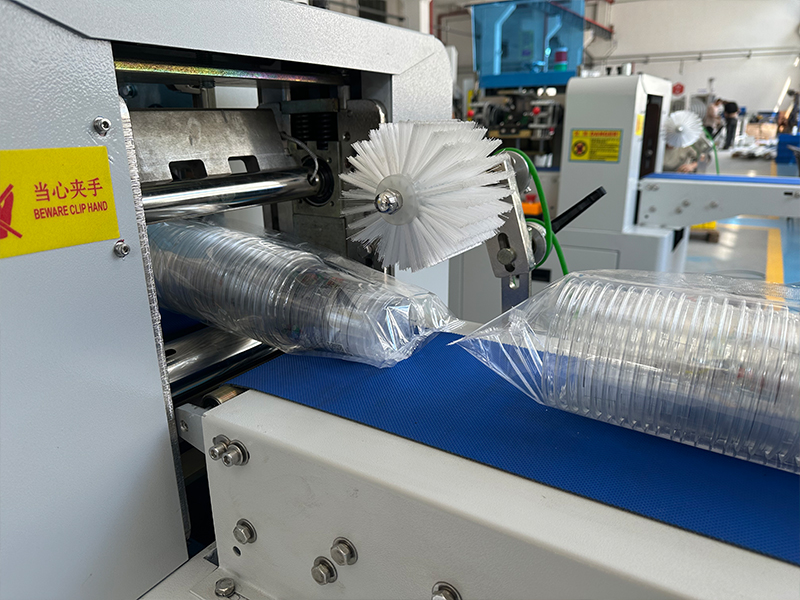
Horizontal Flow Wrapping Machinery, also known as flow wrappers in our industry, is mainly used to wrap individual products in protective film, such as snacks, small electronic products, cosmetics, etc. After wrapping, they are clean and can prevent damage, which is a very important part of End Of Line Packaging (EOL Packaging). It also comes in fully automatic and semi-automatic versions — choosing the right one can save a lot of trouble. A fully automatic Horizontal Flow Wrapping Machinery can be connected to the entire End Of Line Packaging production line, with automatic product feeding, automatic packaging, and automatic edge sealing — all without manual intervention. It can wrap hundreds of products per minute, with fast speed and uniform packaging, making it suitable for factories with standardized products and high output, such as snack processing factories with mass production — it is perfect for them. The semi-automatic one requires the operator to place the products on the conveyor belt, and then the machine performs packaging and edge sealing. Although it is a bit slower, it is flexible: when the product size or specification changes, the machine can be adjusted slightly for use, making it suitable for factories with small-batch and customized products. Here, I’ll give you some practical data that customers often ask about: a fully automatic flow wrapping machine can wrap 3,400 packages per hour with an efficiency of 92%; a semi-automatic one can wrap 1,200 packages per hour, and its upfront cost is 78% cheaper than the fully automatic one. You can choose according to your own output and product type. If you’re not sure, you can also ask us at Wuxi Transfu to help you match accurately.
3 How Other End of line packaging machine Components Assist in Automation Choices
In addition to Case Sealer and Horizontal Flow Wrapping Machinery, there are other End of line packaging machine components that will also affect your choice between fully automatic and semi-automatic. Let’s talk about it practically to avoid everyone stepping on pitfalls. For example, palletizers are used to stack finished packages on pallets — fully automatic ones are robotic palletizers that require no manual handling, saving effort and being neat, suitable for high output; semi-automatic ones require manual cooperation with machine-assisted stacking, suitable for small and medium-sized factories to save costs. There are also labelers, check weighers, conveyors, etc., which also have fully automatic and semi-automatic differences. Here’s a key suggestion for you: when choosing equipment, you must ensure that all components can work together seamlessly. Don’t choose a fully automatic production line but match it with a semi-automatic Case Sealer — this will slow down efficiency and cause bottlenecks. For example, a fully automatic End Of Line Packaging (EOL Packaging) production line must be equipped with a fully automatic Case Sealer, Horizontal Flow Wrapping Machinery, and robotic palletizer to achieve seamless connection; if it’s a semi-automatic production line, you can match it with a semi-automatic Case Sealer plus manual palletizing to balance cost and efficiency. In addition, conveyors, check weighers, etc., should also match the level of automation. For example, a fully automatic production line is best equipped with an automatic check weigher and an automatic rejection system for unqualified products to save labor; for a semi-automatic one, manual inspection can also cope. If you’re not sure about these details, feel free to contact us at Wuxi Transfu — we’ll help you plan a suitable configuration to avoid waste.