Introduction: A New Era of Humans and Robots Working Side by Side on Packaging Lines
Packaging lines have always worked in two separate ways for a long time. On one side, you’ve got fast, fixed industrial robots locked behind safety fences. On the other, human workers handle delicate jobs that need careful judgment and flexible hands. But big changes are happening fast. Collaborative robots (cobots) are now widely used—they’re built to work right next to people, no bulky safety barriers needed.
For packaging factories, the question isn’t whether to add cobots to their lines. will break down the core technical, safety and daily operation problems behind this industry shift. We’ll also talk about how cobots pair up with common end-line gear: Case Sealer, Palletizing Robot, End-of-Line Automation and Robotic Case Packer.
How Collaborative Robots Actually Work
Regular old industrial robots are built to run alone, but cobots are designed first and foremost to interact safely with people. They come with a full set of safety features to make this possible.Most cobots also have soft outer padding and rounded edges, so even a random collision won’t hurt anyone badly.
Another handy safety trick is speed and distance monitoring. Built-in cameras and area scanners slow the robot down when a person walks close by. If someone steps over the preset safe line, the cobot shuts down completely. All these built-in safety features create a safe shared workspace, and they work seamlessly with End-of-Line Automation equipment like Robotic Case Packer, Case Sealer and Palletizing Robot.
Safety Rules & Risk Checks: You Can’t Skip These
Every cobot setup needs a full, written risk assessment covering every stage: regular production, robot programming, machine maintenance and fixing breakdowns.
Take an example: if you set up cobots alongside a Palletizing Robot as part of your End-of-Line Automation system, you can’t only check how each robot moves alone.Common fixes to cut risks include extra light curtains around the work zone, pressure-sensitive safety mats under the Palletizing Robot, and solid guards at super dangerous spots. This mixed safety setup keeps things flexible while protecting staff.
Where Cobots Fit Best on Modern Packaging Lines
Cobots shine on specific spots of packaging lines—their flexibility fills the gaps where human workers’ quick thinking is irreplaceable. Below are the most common use cases tied to End-of-Line Automation gear: Robotic Case Packer, Case Sealer and Palletizing Robot.
End-of-Line Palletizing
Stacking boxes onto pallets is still the most popular job for cobots. The Palletizing Robot handles all the boring, heavy lifting of stacking boxes in different layouts, while people focus on checking product quality, sticking labels on boxes and swapping slip sheets.
For factories making lots of different products at once, cobots are super easy to re-program for new box sizes or stacking styles. This is a huge win for flexible End-of-Line Automation.
Loading & Feeding Work for Robotic Case Packer & Case Sealer
Cobots are perfect for feeding materials into semi-automatic packaging machines. The most typical job is loading empty carton blanks into a Robotic Case Packer, then moving filled boxes over to a Case Sealer.
We have to set safety lock rules to stop the cobot arm from reaching into the Case Sealer’s working area while the sealing machine is running—this stops crashes between the robot arm and sealing parts.
Quality Checks & Sorting for End-of-Line Automation
Cobots fitted with cameras can work alongside people at inspection stations on your End-of-Line Automation line. They pick defective goods off the pallet conveyor and hand them to workers to double-check. This team work speeds up the whole production line a lot.
The main safety things to watch out for: fast-moving pallet conveyors, and how workers, cobots and the downstream Palletizing Robot coordinate movements after the Case Sealer and Robotic Case Packer.
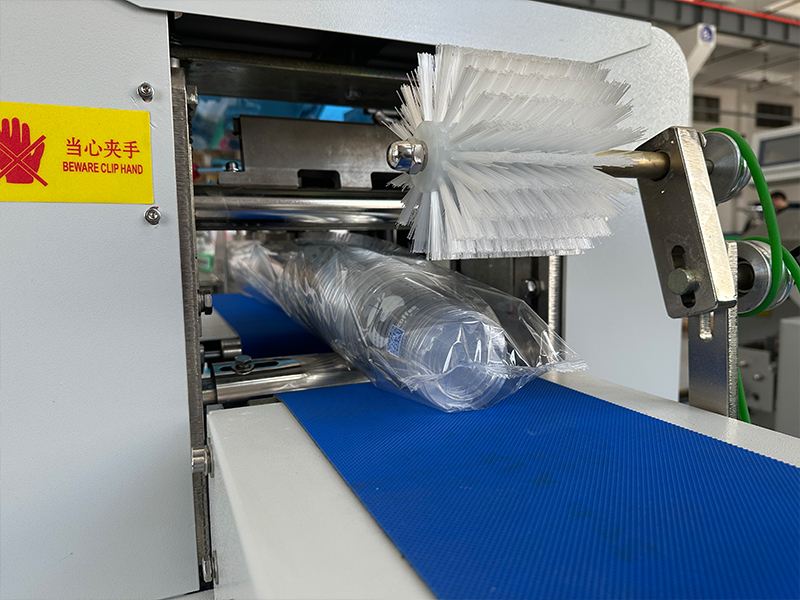
Palletizing Machines + Cobots: How They Boost Each Other
Palletizing machines have long been the workhorse of shipping areas. Traditional fully automatic palletizers are fast, but they’re stiff to adjust and take up tons of floor space. If you use cobots alongside or instead of old palletizing machines, you’ll get a far more flexible End-of-Line Automation station combining Robotic Case Packer, Case Sealer and Palletizing Robot.
Cobot palletizing cells fit into much smaller spaces, and you often don’t need full surrounding safety fences. Teaching the robot new stacking patterns is simple—just drag the arm by hand, and it learns in minutes instead of hours. That makes this setup ideal for factories that make small-to-medium batches with constantly changing products.
No matter if your pallet station is fully automatic or cobot-assisted, you have to run full safety checks: the robot arm’s moving path, how stable stacked boxes are, and all the connecting points between upstream Robotic Case Packer, Case Sealer, pallet conveyors and the Palletizing Robot.
Supporting Equipment Matters: Safety Depends on Your Whole End-of-Line Automation Line
Safety isn’t just about the cobot itself—it’s a full-system issue. The cobot is only one piece of your End-of-Line Automation setup, and how it links with other gear like Robotic Case Packer, Case Sealer and Palletizing Robot decides overall safety. Here’s what you need to pay attention to for peripheral machines:
Pallet Conveyors Conveyors have to be locked to the cobot’s control system. When someone’s programming the cobot or doing maintenance near the Palletizing Robot, the conveyor can’t send new pallets into the work zone.
Robotic Case Packer & Case Sealer When cobots feed empty cartons to a Robotic Case Packer or pass sealed boxes to a Case Sealer, safety hardware locks need to shut down the packing and sealing machines if the cobot arm drifts into dangerous zones. This relies on safety-grade PLCs to sync signals across all End-of-Line Automation machines.
Workstation Layout Basics Put emergency stop buttons everywhere easy to reach, and install tower lights to show real-time status for cobots, Robotic Case Packer, Case Sealer and Palletizing Robot. Plan the layout around how workers naturally move—don’t make staff stretch awkwardly or constantly walk through the robot’s moving area.
Training & New Work Habits: Humans Are Key to Safe Collaboration
Even the best End-of-Line Automation gear—cobots, Robotic Case Packer, Case Sealer and Palletizing Robot included—can’t fix safety risks caused by workers not knowing how to use them properly. Using cobots means changing everyone’s mindset: before, people stayed far away from robot fences; now, they work closely with robots as teammates.
All operators and maintenance staff need thorough training. They have to know what cobots can and can’t do, and tell the difference between a harmless light bump and a situation where they need to hit the emergency stop right away. This builds a shared safety culture: the End-of-Line Automation machines are built to keep people safe, and workers follow rules to avoid accidents too.
Safe, Productive Production Comes With Collaborative End-of-Line Automation
Real factory experience proves cobots can safely slot into packaging lines as part of a full End-of-Line Automation system with Robotic Case Packer, Case Sealer and Palletizing Robot—but safety doesn’t happen on its own.
It all comes down to careful advance planning, sticking to international safety standards, designing your whole workstation around all connected packaging machines, and investing time in training your team. When cobots work together with Robotic Case Packer, Case Sealer and Palletizing Robot, you get a brand new efficient workflow: robots handle repetitive, heavy, boring tasks, while humans oversee quality, adjust settings and solve unexpected problems.
If you plan your whole End-of-Line Automation system with safety as a top priority, factories can fully unlock the benefits of human-robot teamwork. You’ll end up with packaging lines that run faster, adapt easier, and keep your most important asset—your workers—safer and less worn out on the job.


