

The beverage industry runs on variety. Whether it's those tiny 200-ml "mini" cans you grab at checkout or the giant 2.5-liter PET bottles meant for family dinners, the sheer number of SKUs out there can be a logistical headache. For production managers, the era of running one format for months straight is long gone. These days, a single plant might have to pivot multiple times in one shift—jumping from sleek aluminum bottles to square HDPE juice jugs, then over to lightweight PET bottles for carbonated drinks.
At the heart of this operational complexity lies the post-packaging production line. This is the critical phase where primary packages (bottles) are collated, packed into secondary packaging, and prepared for shipment. If the filling line is the heart of the operation, the post-packaging line is the nervous system—and it must be highly adaptable.
To remain profitable, beverage companies are moving away from hard-coded automation toward automated packaging line solutions that prioritize flexibility. This article explores how modern end-of-line equipment achieves the agility required to handle multi-size beverage bottles without sacrificing throughput.
The Anatomy of a Modern Post-Packaging Production Line
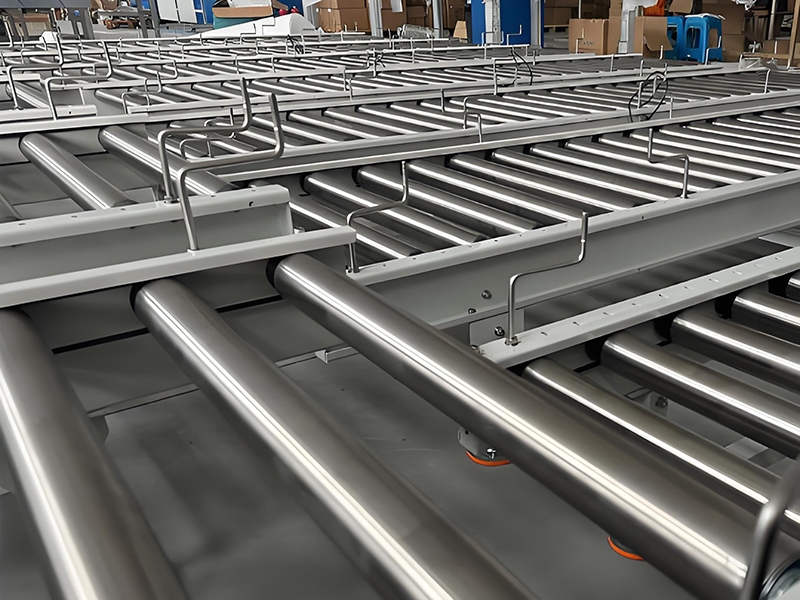
To understand flexibility, one must first understand the components of the line. A typical post-packaging production line for beverages begins where the filler ends. It usually consists of container handling systems (conveyors and combiners), primary collation (film wrappers or tray packers), case packing, and finally, palletizing and load securing.
Traditionally, these lines were mechanically driven. Changeovers required physical parts to be swapped out—change parts for lane guides, new gripper heads for the palletizer, and adjustments to the infeed screws. This mechanical rigidity is the enemy of the modern beverage plant.
Today’s lines rely on servo-driven technology and quick-release mechanisms. The line is no longer a single, rigid machine but a series of intelligent modules. When a line receives a signal that a batch of 500-ml bottles is finishing and a run of 1.5-L bottles is starting, the entire line adjusts automatically. Lane guides widen, infeed speeds adjust based on bottle mass, and the robotic palletizer selects a new stacking pattern from its library. This transition, which once took an hour of manual labor, can now happen in minutes.
Retooling the Infeed: Conveying and Dividing with Precision
The first major hurdle in a multi-size environment is simply moving the bottles without jams or tipping. Lightweight bottles, especially 250-500ml sizes, are prone to instability at high speeds. Heavier, larger bottles require different handling dynamics.
Flexible automated packaging line solutions now utilize "soft handling" technology. Air conveyors and servo-driven timing screws are programmed with multiple profiles. For a small, lightweight bottle, the system applies gentler pressure and lower back pressure to prevent buckling. For a larger, more stable bottle, the line increases throughput speed.
Mechatronic dividers and combiners have replaced mechanical guides. Instead of fixed rails, motorized lane guides adjust their width automatically based on the bottle diameter. This ensures that whether the line is running a slender 70mm bottle or a wide 120mm bottle, the product flows smoothly into the downstream packer without requiring a physical tool change.
The Packing Station: Servo-Driven Flexibility in Action
The core of the post-packaging production line is the packing station, where bottles are grouped and placed into trays or cartons. For multi-size adaptability, two technologies dominate: robotic pick-and-place and advanced continuous motion wrappers.
Robotic Grouping and Loading
In many high-speed lines, delta robots or top-loading Cartesian robots are used to grasp bottles and place them into trays. This is inherently flexible because the end-of-arm tooling (EOAT) is often the limiting factor. However, modern EOATs utilize vacuum or bladder-style grippers that conform to different bottle neck sizes, or they use servo-driven adjustable rails that grip the bottle body regardless of diameter.
When a size change exceeds the physical grip range, quick-change tooling heads allow the robot to automatically disengage one tool and pick up another from a storage rack. This level of automation ensures that the robotic palletizer downstream isn't starved for product due to a lengthy changeover at the packer.
Film and Wrapping Adaptability
For lines using shrink film to create multipacks or trays, flexibility is achieved through film reel management and servo-controlled forming shoulders. A flexible line can handle different pack patterns—say, a 2x3 pack for small bottles and a 3x4 pack for larger ones—without changing the film width. The machine simply adjusts the forming plow and the sealing jaws.
Robotic Palletizing: The Linchpin of Format Flexibility
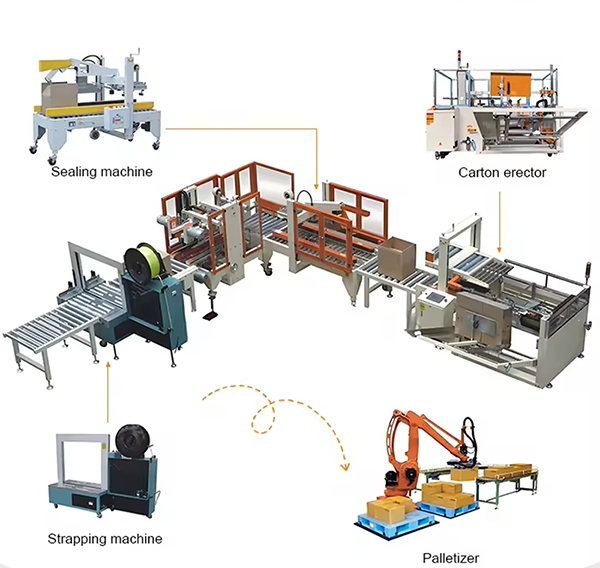
Once the bottles are cased or bundled, they arrive at the end of the line. This is where the robotic palletizer proves its value. Unlike traditional high-infeed palletizers that rely on complex stripper plates and aprons designed for a single case size, robotic palletizers operate purely through software.
A modern robotic palletizer can handle mixed loads effortlessly. When switching from a tall, thin case containing 1-liter bottles to a short, wide case containing 2.5-liter bottles, the robot’s programming dictates the change. The gripper adjusts its reach, and the robot path planning software recalculates the most efficient stacking pattern to ensure pallet stability.
Recent innovations highlighted at industry trade shows include collaborative palletizing workstations that can handle payloads up to 45kg. These systems support multiple pick-and-place modes and can store over 500 palletizing patterns. If a beverage plant introduces a new bottle size tomorrow, the operator simply inputs the case dimensions into the HMI, and the palletizing algorithm generates a stable pattern instantly, eliminating the need for manual trial and error .
Securing the Load: The Role of the Automatic Stretch Wrap Machine
The final physical step in the post-packaging production line is securing the mixed-load pallet for shipment. A pallet containing various case sizes often has an uneven top surface and voids. This is a challenge for standard wrapping.
An advanced automatic stretch wrap machine contributes to flexibility through intelligent film placement. Modern machines are equipped with "Load Guardian" systems that detect the profile of the load. If the machine senses a void or a protruding layer, it adjusts the film carriage to apply containment force precisely where it is needed, rather than just wrapping in a fixed spiral pattern.
Furthermore, the interface between the palletizer and the wrapper must be seamless. With the rise of Autonomous Mobile Robots (AMRs) and flexible conveyor layouts, some facilities are moving away from fixed turntables. Newer automatic stretch wrap machine models are designed with "AMR integration" capabilities, allowing them to receive pallets directly from mobile robots or to feature mobile wrapping units that travel to the pallet. This is particularly useful for oversized or unstable loads that cannot be conveyed traditionally .
Software and Controls: The Brain Behind the Brawn
The physical adaptability of servos and robots is useless without a central nervous system. A truly flexible post-packaging production line relies on a Manufacturing Execution System (MES) or a line controller that communicates with all upstream and downstream equipment.
When discussing automated packaging line solutions, the focus often falls on hardware. However, the "automation" truly lies in the software. Recipe management is critical. An operator selects "SKU 12345" from a tablet, and the following occurs simultaneously:
The lane dividers adjust to the new bottle diameter.
The case packer selects the correct packing pattern (e.g., 12 bottles per case).
The robotic palletizer switches its tooling and selects the pallet pattern for 12-bottle cases.
The automatic stretch wrap machine adjusts the pre-stretch ratio and top-sheet application based on the load's fragility and weight.
This level of integration ensures that changeovers are not just fast, but error-proof. It removes the human variable from the equation, ensuring that a heavy bottle isn't accidentally placed on a stack pattern designed for lightweight cases, which would lead to collapse.
Conclusion: Future-Proofing Through Adaptability
As beverage packaging continues to evolve—with lighter weights, recycled content (rPET) that changes material behavior, and new shapes designed to stand out on shelves—the post-packaging production line must be more adaptable than ever.
Investing in flexible automated packaging line solutions is no longer a luxury but a necessity for competitiveness. By integrating servo-driven adjustments, versatile robotic palletizer cells, and intelligent automatic stretch wrap machines, beverage producers can turn their end-of-line operations from a bottleneck into a competitive advantage.
The factory of the future will not be defined by how fast it runs a single SKU, but by how quickly it can switch to the next. And that future is built on the flexibility of the post-packaging line.