

The packaging line of a traditional manufacturing facility was built on predictability. For decades, the rhythm was consistent: a single stock-keeping unit (SKU), a uniform case size, and a steady flow to pallet. Then came the e-commerce explosion.
In today’s fulfillment-driven market, the days of running one box size for eight hours are vanishing. Modern warehouses and high-mix manufacturing facilities now face a volatile stream of orders requiring dramatically different packaging geometries. This shift has exposed a critical bottleneck: the carton erector.
As order profiles fragment, the ability of a case erector to adapt instantly is no longer a luxury—it is the dividing line between profitability and operational chaos. The central question echoing through distribution centers is whether traditional equipment can survive the era of random case sizes, or if a new generation of automation is required to keep pace.
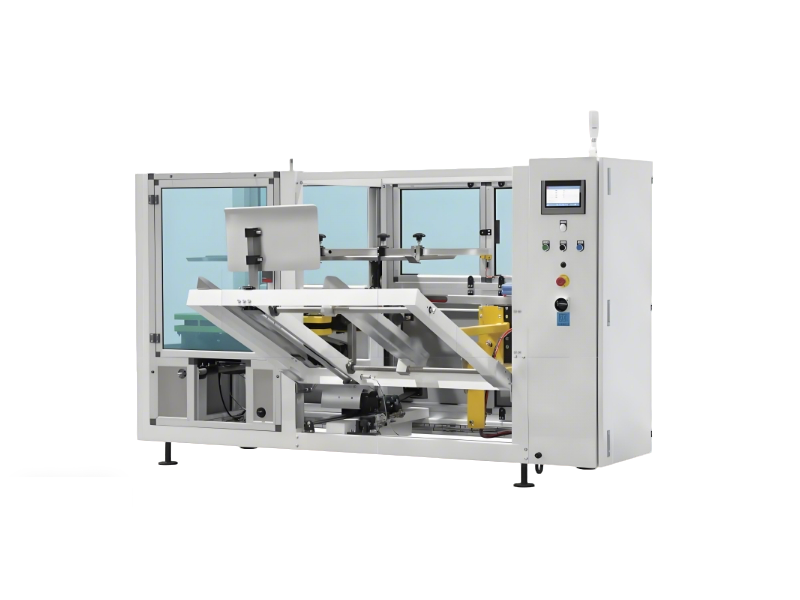
The random case dilemma: breaking the single-size paradigm
To understand the pressure on the carton erector, one must first examine the anatomy of an e-commerce order. Unlike bulk palletized shipments destined for big-box retailers, direct-to-consumer (DTC) orders are defined by variety. A single wave might contain a lightweight polybag requiring a six-inch cube, followed by a bulky but light item necessitating a long, flat container.
Traditional carton erector—specifically those designed for high-speed, single-size production—operate on a principle of rigidity. They utilize fixed magazines and forming heads that require manual adjustment via wrenches and physical repositioning. In a facility running 50 different case sizes per shift, this manual intervention translates directly to downtime.
This is where the concept of the carton forming machine enters the conversation. Unlike its predecessor, a carton forming machine is engineered to process a mix of case sizes arriving in sequence without stopping the line. Using servo-driven mechanisms and optical sensors, these systems measure the flat blank as it enters the magazine, automatically adjusting the forming head, flap folders, and taping heads to accommodate the specific dimensions. For operations where the SKU count is measured in the thousands, this ability to handle random case sizes without mechanical changeover is the only viable path to throughput.
The domino effect: from case forming to palletizing machines
The performance of the erector machine does not exist in a vacuum. It dictates the efficiency of every downstream process, creating a chain of dependencies that ultimately terminates at the palletizing stage.
When an erector machine fails to handle random case sizes effectively, the consequences ripple outward. Jams at the case former cause starvation for the packing stations. However, a more insidious problem occurs when the erector machine produces cases with poor squareness. If a case is slightly trapezoidal due to a misaligned forming head—a common issue when switching sizes without full calibration—it will not seal correctly on the case erector and packer .
Modern carton sealing machines rely on consistent pressure and alignment to apply tape or glue uniformly. A compromised case causes tape to wrinkle or fail, leading to rejected packages, rework, and frustrated labor. Furthermore, if the case dimensions are inconsistent, the robotic arms or palletizers downstream cannot calculate a stable layer pattern.
Sophisticated palletizing machines require precise dimensional data to build stable loads. If the erector machine introduces variance in height or width, the palletizer may create an unstable stack, leading to collapsed loads in transit. In high-volume e-commerce fulfillment, the integration between the random case erector, the carton sealing machine, and the palletizing machines must be seamless. A breakdown in any one of these three nodes disrupts the entire logistics flow.
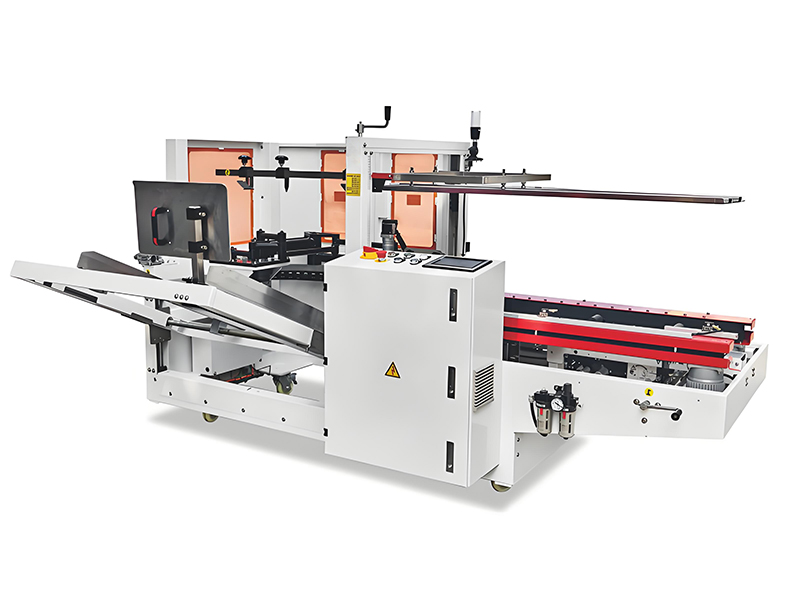
Servo-driven flexibility: the technical evolution
The technological leap in case erecting is defined by the shift from mechanical to electronic control. To handle random case sizes with speed, modern erector machines rely on a combination of high-torque servo motors and advanced programmable logic controllers (PLCs).
A contemporary random case erector operates using recipe management. When a barcode is scanned on an incoming order, the PLC instantly recalls the exact parameters for that box: blank width, length, height, board grade, and seal pattern. Within milliseconds, servo motors reposition the side rails, adjust the backstop, and set the vacuum cup placement.
This is fundamentally different from the manual adjustments required by legacy equipment. In a facility processing 300 different case sizes daily, the cumulative time saved by eliminating manual changeovers can exceed four hours per shift. That recovered time translates directly to increased throughput capacity without requiring additional square footage.
Moreover, the mechanical gentleness of servo-driven forming is critical for sustainability efforts. As the industry shifts toward lighter, recycled, and thinner corrugated materials to reduce packaging waste, the margin for error shrinks. A pneumatic or mechanically driven erector machine may fracture or stress these lightweight boards, creating micro-cracks that compromise structural integrity. A servo-controlled random case erector, however, offers variable speed control during the forming cycle, applying slower, more deliberate force when handling fragile board grades to ensure case integrity.
The sealing station: a critical integration point
While the forming head gets the attention, the interface between the erector machine and the carton sealing machine is where operational efficiency is truly tested. In a random environment, the sealing system must communicate directly with the case former to anticipate the next box.
Advanced carton sealing machines integrated into random lines utilize floating heads that self-adjust to the width and height of the incoming case. However, latency issues can arise if the erector machine does not transmit dimensional data quickly enough. For optimal performance, the sealing station requires pre-programmed data to raise or lower its top head before the case enters the compression section.
If the erector machine delivers a tall case to a sealing head set for a short case, the result is a jam that requires manual clearing. Conversely, if the sealing head is set too high for a short case, the flaps remain unsealed. In the context of high-speed e-commerce, even a 1% failure rate at this junction can result in hundreds of unsealed packages per day, creating security risks and customer dissatisfaction.
To mitigate this, modern lines employ a unified control architecture where the random case erector, the carton sealing machine, and the palletizing machines share a single data stream. This “machine-to-machine” communication ensures that by the time the case blank is pulled into the erector, the sealer is already positioning its heads for the specific dimensions of that box.
Palletizing machines and the need for data integrity
The end of the line presents the final test for the erector machine: consistent palletization. Automated palletizing machines rely on pattern generation software that calculates the optimal arrangement based on case dimensions.
If the erector machine produces cases with variable dimensions—specifically height—it creates a nightmare for the palletizer. In a mixed pallet scenario, where several orders are stacked together, height variance prevents interlocking patterns. The palletizer must either slow down to measure each case dynamically or risk building an unstable tower.
To solve this, facilities utilizing random case erector technology often implement inline dimensioners. These devices verify the case size after sealing and before palletizing, feeding real-time corrections back to the erector machine and carton sealing machine. This closed-loop system ensures that the data sent to the palletizing machines matches the physical reality of the box. Without this calibration, the efficiency of the palletizer is compromised, and the risk of product damage during transport increases exponentially.
Sustainability and total cost of ownership
Beyond throughput, the question of whether an erector machine can handle random case sizes has significant implications for total cost of ownership (TCO) and sustainability goals. E-commerce packaging is under intense scrutiny regarding material usage. Shippers are aggressively pursuing “right-sized” packaging—using the smallest possible box for each item to reduce cardboard waste and shipping cubic volume.
A fixed-size erector machine forces operators to overbox items. If the machine cannot form a box smaller than 12 inches, but the product fits in an 8-inch cube, the company pays for additional cardboard and dimensional weight shipping charges.
A flexible random case erector enables just-in-time right-sizing. By allowing the facility to stock a broader range of flat blanks and form them on demand, the system eliminates the need for void fill and reduces the overall carbon footprint of the shipment. This alignment with environmental, social, and governance (ESG) criteria is increasingly becoming a non-negotiable requirement for publicly traded retailers and brand owners.
Conclusion: adaptability as the new standard
The e-commerce surge has fundamentally rewritten the rules of packaging automation. The question posed to operations managers is no longer simply about the speed of the erector machine, but about its intelligence and range.
As order profiles become increasingly random and unpredictable, the equipment that defined packaging lines a decade ago is struggling to keep up. The facility that invests in a random case erector gains more than just a box-forming device; it gains a cohesive system that integrates seamlessly with the carton sealing machine and palletizing machines to create a unified, data-driven workflow.
In the current market, the ability to handle random case sizes is not just a technical specification—it is a strategic advantage. Those who fail to adapt will find their packaging lines becoming the bottleneck in a supply chain that demands speed, flexibility, and precision. For those who upgrade, the reward is a packaging operation that can scale with the unpredictable nature of modern commerce, turning the chaos of random sizes into a streamlined, profitable process.