

The math no longer works. For decades, food producers could throw bodies at the end of the line—stacking cases, wrapping pallets, feeding cardboard blanks into machines. Those days are ending.
Recent industry data confirms what plant managers feel every shift: nearly 60% of consumer packaged goods companies expect hiring difficulties to intensify in the coming years . The retiring generation of experienced operators isn't being replaced. And the work hasn't gotten easier—if anything, SKU proliferation and tighter retail windows have made the end of line packaging more complex than ever.
This is where automation stops being a capital expenditure discussion and becomes an operational necessity. The post-packaging production line—that critical stretch from the moment product leaves primary packaging until it sits on a truck—has become the battleground for profitability in food manufacturing.

The workforce reality hitting food manufacturers
Walk into any food plant today and you'll see the same picture: end-of-line positions that stay open for months, temporary workers who don't return after lunch, and veteran operators counting days until retirement.
The PMMI workforce survey paints a stark picture. CPG companies report struggling to hire skilled operators and technicians, with the problem exacerbated by experienced staff retiring and high turnover among new hires . The knowledge walking out the door isn't just about running equipment—it's about troubleshooting, about knowing what a machine sounds like before it fails, about the thousand small judgments that keep a post-packaging production line running at 95% efficiency instead of 70%.
Lisa Rathburn, vice president of operations at Marzetti Company, puts it directly: the gap isn't just about not having enough people. It's about not having people with the right skills as manufacturing technology advances . Food plants need workers who understand compliance, can troubleshoot on the fly, and feel comfortable with digital tools. Those people don't grow on trees.
Why the post-packaging production line is the pressure point
Here's what plant operators know but rarely say: the post-packaging production line is where most of the pain lives.
Primary packaging gets all the attention—the form-fill-seal machines, the fillers, the high-speed flow wrappers. But the back half of the line? That's where product stacks up. That's where bottlenecks form. That's where manual handling introduces variability, where heavy lifting causes injuries, where inconsistent stacking leads to pallets that collapse in transit .
Bizerba's Oliver Deifel describes the end-of-line segment as often overlooked but strategically critical. Labelling, inspecting, stacking, palletising—these steps are still frequently performed by hand. Yet with rising quality standards, increasing traceability demands, and labor shortages, this part of production is becoming a strategic pressure point .
The numbers bear this out. When Dale Farm Foods looked at its cheese operation, it was facing a problem that no amount of hiring could fix: twenty-kilogram blocks of cheddar, ten blocks per layer, five layers high. One thousand kilograms of cheese per pallet. All stacked by hand . That's not a job people line up for. That's a job that burns through bodies.
Automated packaging line solutions: moving beyond point solutions
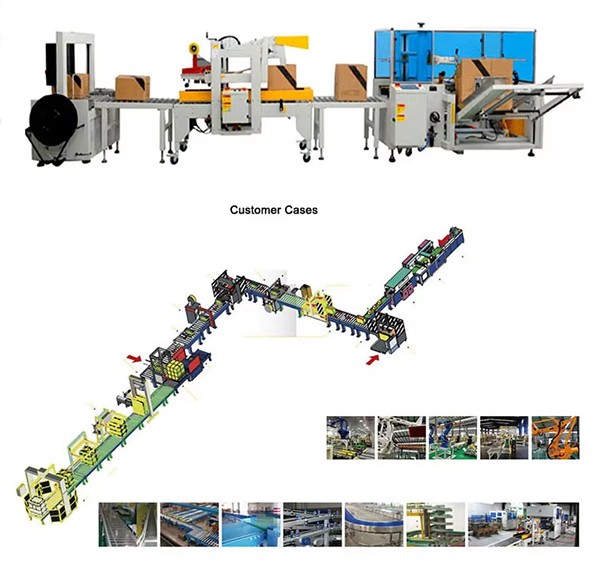
The industry has moved past the era of buying standalone machines and hoping they connect. Today's approach to the post-packaging production line requires thinking about the entire flow from case packing to truck loading.
MULTIVAC's approach at FACHPACK 2025 demonstrated this shift. The company showcased fully automated lines where tray sealers, conveyors, inspection systems, and robotic case packing work as an integrated whole . The goal isn't just to automate individual tasks—it's to eliminate the buffers and bottlenecks that form between them.
For food manufacturers, this means looking at automated packaging line solutions that address the full scope of end-of-line activity. A case packer that runs at 60 cases per minute doesn't help if the palletising area can't keep up. A stretch wrapper that cycles in 90 seconds creates problems if cases arrive in uneven flows.
The integration piece matters because food plants run multiple SKUs—sometimes dozens—on the same post-packaging production line. PWR Packaging, which has installed more than 2,500 robots across food facilities, emphasizes changeover speed as the critical metric. Their delta-robot solutions can swap grippers and adjust parameters in under a minute, with one-touch recipes that store settings for different products . This matters because a line that takes two hours to change over isn't flexible enough for modern food production.
Robotic stretch wrapper adoption accelerates
Walk the floor of any packaging trade show today and you'll see them: robotic stretch wrappers that roam the plant floor, wrapping pallets wherever they sit rather than requiring pallets to come to a fixed machine.
The market data tells the story. The global robot stretch wrapper market is projected to grow from US$656 million in 2025 to US$894 million by 2031, driven by demand across food, beverage, and logistics . This isn't niche technology anymore—it's becoming standard equipment.
Robopac's Robot S7 exemplifies the category: a self-propelled wrapper that handles loads of any shape, size, or weight . For food plants with constrained floor space or varying pallet configurations, this mobility matters. The wrapper comes to the pallet, not the other way around.
What's driving adoption isn't just labor savings—though those are real. It's consistency. A robotic stretch wrapper applies the same tension, the same film overlap, the same wrap pattern to every pallet. No variation between shifts. No "good enough" on Friday afternoon. Every pallet leaves the building with the same stability.
The integration of artificial intelligence and machine learning into these systems adds another layer. Modern robot stretch wrappers can learn and adapt to different packaging requirements, improving efficiency and productivity over time . For food manufacturers running varying case sizes and pallet configurations, this adaptability translates directly to reduced film usage and fewer damaged loads.
Automatic palletizing system: the heavy lifting solution
If there's one area where labor shortages hit hardest, it's palletizing. The math is simple: palletizing requires reaching, lifting, twisting, and stacking. Hour after hour. Shift after shift. Bodies break.
The automatic palletizing system has evolved significantly to address this. Vention's Rapid Series Palletizer, launched in mid-2025, represents the current state of the art: modular, deployable in days rather than months, and capable of stack heights up to 136 inches . The system integrates with modular conveyors, box erectors, and case packers—all managed through unified software.
For food manufacturers, the appeal isn't just eliminating manual lifting. It's about what happens to the people who used to do that work. John Power, managing director of Power Food Technology, makes the point directly: by leaving robots to do repetitive, heavy, potentially dangerous jobs, food producers can divert employees to carry out more value-added tasks . The robot lifts the cheese. The person manages the process, troubleshoots exceptions, and focuses on things that require human judgment.
The Dale Farm installation illustrates the impact. The company needed to increase palletising output from 9.5 tonnes per hour to 15.5 tonnes per hour while handling two product types simultaneously with full traceability . The solution: a Fanuc M-410iC/185 high-speed palletising robot running 20 hours per day, 355 days per year. That's throughput no manual team could sustain.
Integration and software: the hidden layer
Here's what equipment vendors don't always emphasize: hardware is only half the solution. The software that connects machines, manages recipes, and provides visibility matters just as much.
GREIF-VELOX's FOOD CONNECT 2025 event demonstrated fully automated lines where every setting adjusts automatically for each individual bag—independently and in real time . No operator intervention. No manual measurements. The machine sees the bag and adjusts.
This level of automation requires robust software infrastructure. Bizerba's BRAIN2 platform adds transparency and traceability, enabling quality audits and performance monitoring in real time . For food manufacturers subject to increasing regulatory scrutiny, this visibility isn't optional—it's required.
The software layer also addresses one of the hidden costs of automation: training. PMMI's research found that only 14% of CPG companies rank printed manuals as the most effective method for onboarding operators . The future is video content, human-machine interface step-throughs, and picture-driven manuals accessible at the point of work.
Vention's approach includes real-time expert support accessed directly through the machine pendant—live video assistance from automation specialists when problems arise . This matters because the alternative is waiting for a service technician to arrive, which means downtime measured in days rather than hours.
Making the business case in today's environment
The barrier to automation has never been technical—it's always been financial. Food manufacturers operate on thin margins. Capital requests get scrutinized. Payback periods matter.
But the calculation is shifting. When PMMI asked equipment manufacturers how often customers discuss workforce challenges, close to two-thirds said they discuss the topic often or always . Labor isn't just an HR issue anymore—it's a production issue. Lines don't run when positions go unfilled.
The ROI model for post-packaging production line automation now includes factors that didn't used to appear in spreadsheets: the cost of temporary agency workers, the overtime premium for mandatory weekend shifts, the quality issues that creep in when inexperienced hands stack cases, the injuries that generate insurance claims and lost days.
Gü Indulgent Foods' experience is instructive. The company needed a second packing line that would fit into a compact area while handling multiple case formats. The solution—designed using Fanuc's Roboguide virtual programming software—integrates depalletising, cartoning, case packing, and palletising in a seamless flow . The result: greater flexibility and increased production capacity without proportional increases in headcount.
The evolution, not revolution, of the food plant
No one is suggesting food plants become completely unmanned. That's not the goal, and it's not realistic. Food production requires human judgment, human intervention, human oversight.
What's changing is where those humans spend their time. Instead of lifting 20-kilogram cheese blocks, they're monitoring automatic palletizing system performance. Instead of wrapping pallets by hand, they're managing robotic stretch wrapper routes. Instead of fighting to keep up with the line, they're optimizing it.
Oliver Deifel frames it correctly: automation in the end-of-line segment isn't a revolution. It's a necessary evolution . It's about building production environments that are agile, efficient, and resilient—even when staffing is tight and customer demands are rising.
For food companies looking at their post-packaging production lines today, the question isn't whether to automate. It's which automated packaging line solutions to prioritize, how to integrate them, and how fast they can be deployed. The labor market isn't getting easier. The product mix isn't getting simpler. The only variable within management's control is how the line runs.
The plants that figure this out first will have a competitive advantage that goes straight to the bottom line. The ones that wait will keep fighting the same losing battle for bodies that don't exist.