

The global cosmetics industry is going through a huge change right now. By 2030, the market for cosmetics and personal care packaging equipment is expected to hit $8.81 billion—and that means brands are feeling a ton of pressure to get their products from the production line to consumers’ hands quicker than ever before.
For years, the end of the production line has been a total bottleneck—think lots of manual labor, repetitive strain injuries, and those big, expensive machines that take up way too much space. But things are starting to change.
With labor shortages, the e-commerce boom, and way more SKUs popping up left and right, cosmetic manufacturers are quickly turning to collaborative palletizing robot to get through this tough stretch.
These nimble, flexible systems are replacing both manual labor and traditional industrial robots. By integrating packaging automation solutions that include compact case palletizer units and synchronized wrapping machine technology, cosmetic companies are not just keeping up with demand; they are future-proofing their entire supply chain. This article explores the deep-seated reasons for this industrial transformation.
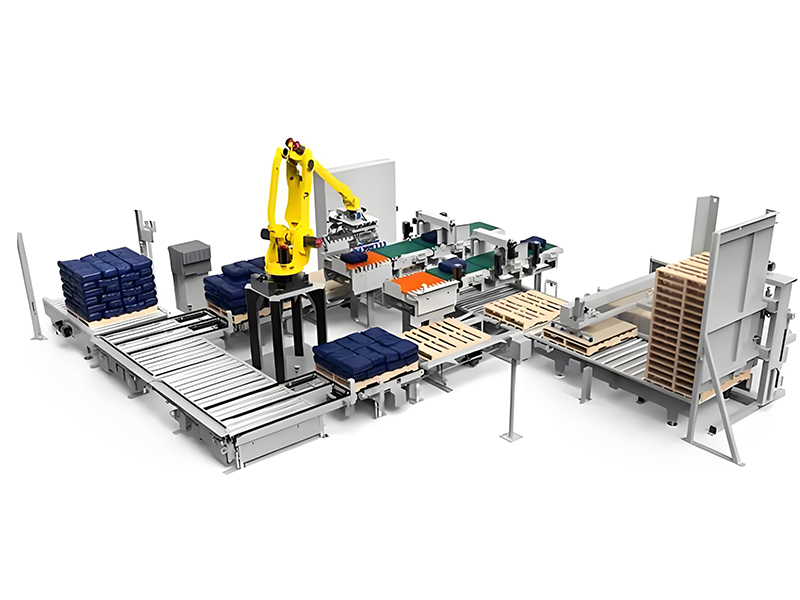
The End-of-Line Bottleneck in High-Mix Cosmetics
To understand the shift toward collaborative palletizing robot, one must first appreciate the unique challenges of the cosmetics production floor. Unlike the beverage or automotive industries, where uniformity is king, cosmetics is a world of high-mix, low-volume runs. A single facility might produce hundreds of different SKUs: glass serums one hour, plastic squeeze tubes the next, and luxury compact cases after that.
Historically, palletizing has been the most labor-intensive step in this process. It requires operators to perform repetitive lifting, twisting, and stacking—movements that lead to ergonomic issues and high turnover rates. While large, industrial palletizing robot exist, they are often ill-suited for this environment. They require massive floor space, dedicated safety fencing, and lengthy changeover times that kill productivity in a high-mix setting .
This is where collaborative robotics bridges the gap. By deploying packaging automation solutions that are designed to work alongside humans, manufacturers can automate the grunt work without re-architecting the entire plant.
Why "Cobots" Are Winning: Flexibility Meets Footprint
Collaborative palletizing robot—often referred to as "cobots"—are the driving force behind this trend. Unlike their industrial predecessors, these units are designed for flexibility and decentralization.
Decentralized Automation
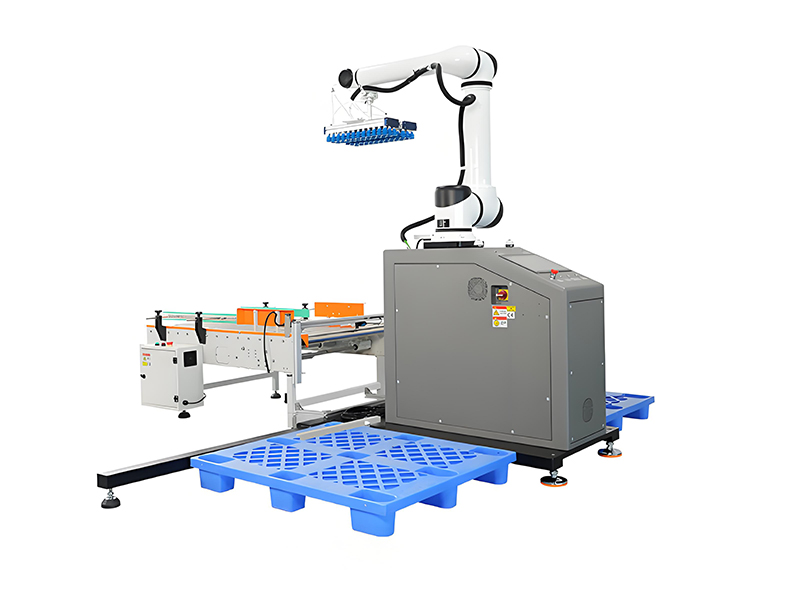
Instead of funneling every product to a single, robot palletizing machine in a corner of the warehouse, collaborative models allow manufacturers to place compact palletizing cells directly at the end of each production line. This decentralized approach fits the physical constraints of cosmetic facilities, where space is at a premium . A cobot palletizer can fit into the footprint of a single pallet, negating the need for conveyor spaghetti.
Rapid Re-tooling for SKU Proliferation
The beauty industry is trend-driven. A viral TikTok video can create overnight demand for a specific lipstick shade or skincare line. Collaborative palletizing machines excel in this chaos. They allow for "on-the-fly" adjustments. Operators with minimal training can manage pallet pattern changes and box size adjustments without calling in an external programmer . This ease of use ensures that production lines remain agile, switching between a holiday gift set and a core skincare line in minutes rather than hours.
Integrating the Ecosystem: Robot Palletizing Machine and Wrapping Machines
The decision to adopt collaborative technology is rarely about the palletizer alone. It is about how these new tools integrate into the broader ecosystem of end of line packaging.
The Role of the Case Palletizer
At the heart of the operation lies the case palletizer. In cosmetic applications, these machines must handle delicate packaging—often featuring high-gloss finishes or intricate labeling—without causing damage. Modern collaborative case palletizer units utilize advanced vision systems and gentle suction or clamping mechanisms to ensure that primary packaging remains pristine .
For example, integrated systems from manufacturers like CAM and IMA are specifically designed for the pharmaceutical and cosmetic sectors, offering "gentle handling" modules that prevent scuffing or crushing . These palletizing machines ensure that despite the high speed of automation, the luxury feel of the product is never compromised.
Synchronization with Wrapping Machines
Once a layer is stacked, the pallet must be stabilized. This is where the integration of the wrapping machine becomes critical. In a fully automated end-of-line solution, the collaborative palletizing machines communicate directly with the stretch hood or stretch wrap equipment.
When a full pallet is built, it is automatically conveyed to an integrated wrapping machine, which applies film to secure the load for transit. Advanced packaging automation solutions now feature smart wrapping machines that adjust tension based on the fragility of the goods—tighter for heavy cartons, looser for lightweight, delicate boxes. This seamless handoff eliminates the need for manual intervention and ensures load stability for e-commerce and retail distribution.
The Economic Imperative: ROI and Labor Realities
The business case for these palletizing machines is compelling. In markets like North America and Europe, labor shortages are not a cyclical issue but a structural reality. Cosmetic manufacturers are finding it increasingly difficult to staff the "three Ds" of palletizing: dull, dirty, and dangerous jobs.
By deploying collaborative automation, companies are seeing Return on Investment (ROI) periods shrink to 12 to 24 months . This rapid payback is achieved not necessarily by firing workers, but by reallocating them. When a collaborative case palletizer takes over the end-of-line, human operators are freed up to manage quality control, oversee multiple lines, or handle the complex packing of promotional displays.
Furthermore, as noted by industry analysts, tariffs on imported stainless-steel components and control systems are driving up the cost of traditional bespoke lines . Collaborative palletizing machines, often modular and software-driven, offer a more predictable capital expenditure, allowing brands to scale incrementally rather than investing in a monolithic system upfront.
Sustainability and Secondary Packaging Synergy
Another factor driving the adoption of packaging automation solutions is sustainability. Cosmetic companies are under intense scrutiny to reduce their carbon footprint and eliminate unnecessary packaging.
Modern collaborative palletizing machines contribute to this goal through precision. By utilizing advanced algorithms to calculate the most efficient stacking patterns, these systems can fit more product onto a single pallet. This reduces the number of truck shipments required and lowers transport emissions.
Additionally, the synergy between the case palletizer and upstream equipment like cartoners and wrapping machines allows for the use of sustainable materials. High-quality wrapping machines can effectively secure pallets using thinner, recycled-content films without compromising load stability . This level of control is difficult to achieve with manual wrapping, where film usage is often inconsistent and wasteful.
Future-Proofing Production
As we look toward the remainder of 2026, the trajectory is clear. The cosmetics industry is moving toward smart factories and Industry 4.0 principles. Collaborative palletizing machines are not just tools; they are data-gathering nodes on the network.
These systems collect data on throughput, downtime, and pattern efficiency, feeding it back to plant managers for continuous improvement. When paired with a modern wrapping machine and a smart case palletizer, the end-of-line transforms from a cost center into a strategic asset.
For cosmetic manufacturers scaling for global export—like the Australian brand Roccoco Botanicals, which cut batch processing time by 75% through automation—the choice is clear . The future belongs to those who can blend the art of beauty with the science of logistics. Collaborative palletizing machines, with their unique mix of flexibility, intelligence, and gentle touch, are the tools making that future possible.