

In manufacturing and logistics, we're always chasing better operational efficiency, but there's this constant headache: we never seem to have enough floor space. Real estate's getting pricier by the day, and with lean manufacturing telling us to cut out all the waste, every square meter's gotta earn its keep.
Now, when it comes to wrapping things up at the end of the production line, choosing the right strapping machine is a big deal. It's not just about whether the straps go sideways or up and down. Nope, it's a strategic move that can shake up how work gets done, keep everyone safe, and make the most of the space we've got.
To determine which type truly conserves floor space, one must move beyond simple footprint measurements and delve into operational integration, material flow, and the ancillary equipment required, such as the telescopic belt conveyor and carton packer systems that often pair with these machines.
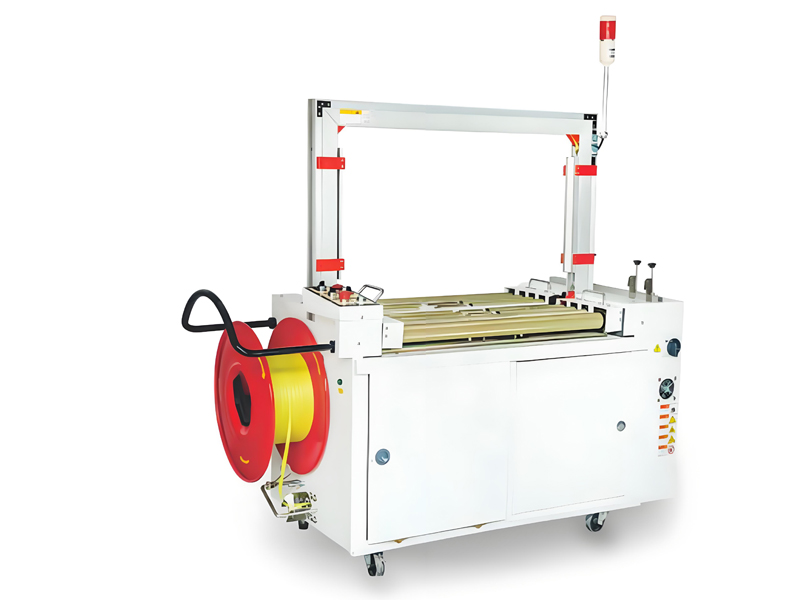
The Space Calculus: Static Footprint vs. Operational Footprint
At first glance, the vertical strapping machine appears to be the undisputed champion of space saving. A typical vertical strapping machine, designed to secure palletized loads, occupies a relatively small floor area—often between two and three square meters. The operator feeds the pallet via a forklift or pallet jack, the machine applies the straps (polypropylene or polyester) around the vertical axis, and the pallet is removed. The machine itself is a self-contained unit.
Conversely, a horizontal strapping machine tells a different story. This type, used primarily for securing long products like lumber, piping, rebar, or long cartons, requires a significant linear footprint. It necessitates infeed and outfeed conveyor systems, often stretching tens of meters. If one judges solely by the footprint of the base unit, the vertical machine wins. However, this is a superficial analysis.
In a modern high-throughput facility, the operational footprint tells a more accurate story. A vertical strapping machine often requires a buffer zone. Operators need space to maneuver forklifts, position pallets accurately, and allow for the machine’s strap feed mechanism to function. Furthermore, if the facility utilizes a carton packer upstream, the vertical strapper usually requires an intermediate accumulation area where pallets are built before being moved to the strapping station. This creates a “space bubble” that can consume 20 to 30 square meters of active floor space when factoring in logistics.
A horizontal strapping machine, while long, integrates directly into a production line. It becomes a seamless extension of the conveyor network. When paired correctly, it eliminates the need for intermediate storage, effectively hiding its footprint within the linear flow of the production line.
Integration with Material Handling Systems
The true efficiency of a strapping machine—and its spatial impact—is revealed when we examine how it interacts with upstream and downstream equipment.
Consider a facility utilizing a high speed strapping machine in a vertical configuration. To achieve the promised throughput, it often requires an automated pallet handling system. This might include a chain transfer, a pallet centering device, and a pallet rotation system if multiple straps are needed. While the core strapping machine remains compact, the ecosystem of conveyors and positioners required to feed it at high speeds expands the spatial requirement dramatically. For a high speed strapping machine operating vertically, the floor space dedicated to the “strapping cell” can rival that of a horizontal line when safety guarding and maintenance access are factored in.
On the other hand, a high speed strapping machine in a horizontal configuration is typically built into a dedicated strapping line. Here, the telescopic belt conveyor becomes a critical component for space optimization. For facilities handling irregular or long-length products, a telescopic belt conveyor is used to extend the conveyor line directly into the loading area or truck. Instead of requiring a large staging area where products are gathered before being fed into the horizontal strapper, the telescopic conveyor allows for just-in-time feeding. The conveyor expands to meet the product, straps it in-line, and retracts. This dynamic use of space—expanding only when needed—is a sophisticated method of reducing the static footprint of the packaging zone.
The Role of Automation: Carton Packers and Line Synchronization
The spatial equation changes fundamentally when automation is introduced. In many modern factories, the strapping machine does not operate in isolation. It is often the final stage following a carton packer.
A carton packer is designed to erect, fill, and seal cartons at high speed. If a facility uses a vertical strapping machine after a carton packer, there is an inherent disconnect in material flow. The carton packer outputs sealed cases at a high rate. These cases must be accumulated, palletized (either manually or by a robotic palletizer), and then transported to the vertical strapper. This requires a significant amount of “buffer space”—a holding area for full pallets waiting for the strapping cycle.
If the facility opts for a horizontal strapping machine placed immediately downstream of the carton packer, the dynamic changes entirely. In this configuration, individual cartons are strapped before palletizing. This is common in industries where individual case integrity is paramount, such as e-commerce or beverage distribution.
By strapping individual cartons horizontally, the facility eliminates the need for a separate pallet strapping zone. The carton packer feeds directly into a high speed strapping machine via a short conveyor. The strapped cases then move to a palletizer. This consolidation of processes eliminates the pallet accumulation buffer entirely. While the horizontal strapping machine itself occupies a linear span, it effectively “steals” space from the palletizing and warehouse staging areas, often resulting in a net reduction of total floor space used for the entire packaging process.
High Speed Dynamics and Maintenance Accessibility
One cannot discuss space saving without addressing maintenance and safety corridors. A common mistake in factory layout is crowding a strapping machine to save space, only to find that operational downtime increases because technicians cannot access the machine for repairs or strap threading.
For vertical strapping machine units, particularly high speed strapping machine models used in heavy industry, maintenance often requires rear access. To save space, facilities frequently push the machine against a wall or column. While this minimizes the machine’s footprint on the production floor, it creates a maintenance nightmare, often requiring the machine to be moved or production halted for extended periods when a major repair is needed.
Horizontal strapping machine configurations, by contrast, are usually designed for line integration. Their modular nature allows the strap head to be positioned on the side or below the conveyor line. Maintenance access is typically designed into the conveyor system’s lateral space. While the line is longer, the width required is often narrower than a vertical machine’s operational zone. For facilities with narrow aisles but long production runs, the horizontal design offers a better spatial fit.
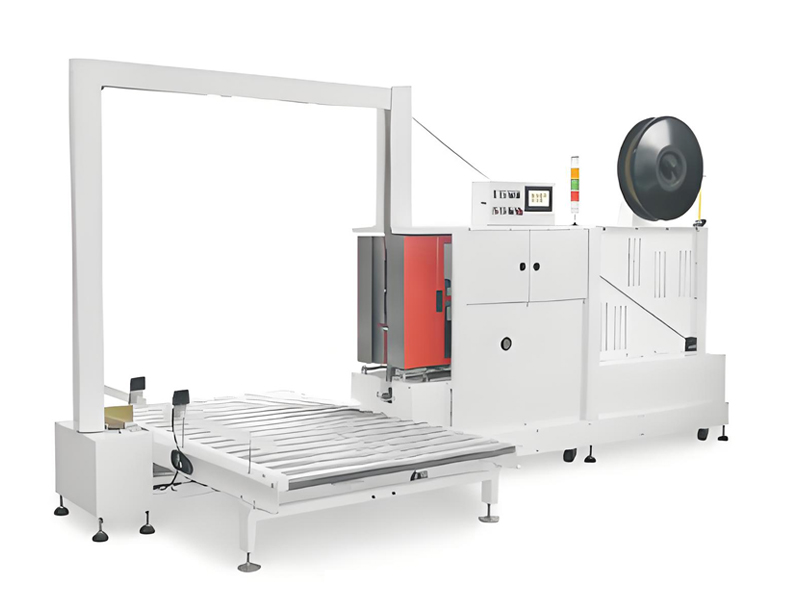
Case-Specific Scenarios: Which Truly Saves Space?
To determine which strapping machine type saves more floor space, we must evaluate based on product type and throughput.
High-Mix, Low-Volume Palletized Goods
If a factory produces a variety of products that are mixed on pallets, a vertical strapping machine is generally the space saver. The machine can be tucked into a corner near the shipping dock. A single strapping machine can service multiple palletizing stations if a forklift is used to transport loads. In this scenario, the horizontal strapping machine would require a dedicated, long line that would be impractical for varied pallet sizes and low throughput.
High-Volume, Uniform Carton Production
If a facility uses a carton packer to produce thousands of uniform cartons per hour, the horizontal strapping machine combined with a telescopic belt conveyor becomes the superior space-saving solution. By integrating the strapping process directly into the conveyor line downstream of the packer, the facility eliminates the palletizing buffer zone. The telescopic belt conveyor further optimizes space by allowing the outfeed to adjust dynamically, removing the need for a long, static accumulation conveyor leading to the truck. In this linear model, the packaging line consumes space, but the storage space is maximized because there is no intermediate pallet staging area.
Long or Unstable Products
For products like steel tubes, lumber, or extruded profiles, a horizontal strapping machine is non-negotiable. While it consumes significant linear floor space, it is the only viable option for stabilizing long bundles. However, the use of a high speed strapping machine in this context, paired with a telescopic belt conveyor, allows for the bundling to occur immediately at the end of the production line. This prevents the need for a massive “staging yard” where products are manually gathered and strapped—a process that consumes exponentially more space than the automated line.
Conclusion
There is no universal answer to whether a horizontal or vertical strapping machine saves more factory floor space. The vertical strapping machine offers the smallest static footprint, making it ideal for facilities with sporadic pallet strapping needs or limited linear space. However, its operational footprint—the space required for pallet staging, forklift maneuvering, and accumulation—can be deceptively large.
The horizontal strapping machine, particularly when integrated with a carton packer and a telescopic belt conveyor, offers a superior solution for high-throughput environments. While its linear length is greater, it consolidates the packaging workflow, eliminates intermediate storage zones, and leverages dynamic conveyance to maximize usable floor space.
For operations seeking to adhere to lean manufacturing principles, the choice should be dictated by the production flow rather than the machine’s footprint alone. In high-speed, automated lines where a high speed strapping machine is essential to keep pace with a carton packer, the horizontal configuration ultimately saves more total factory space by merging the strapping process into the primary flow. Conversely, for diverse, pallet-based operations with lower speed requirements, the vertical strapping machine remains the most space-efficient gateway to secure load containment.